
Unexpected Beauty
Beauty is Not Just for Fascists

I look at media, culture, politics and tech. I like to compare today’s media landscape with that of the past because time is cyclical and the past is prologue.
Also special thanks to Ross Barkan for including me in his piece about New Cultural Criticism. Go give that a read if you have not already.
Megan Gafford wrote a remarkable article in Quilette about how beauty is the primary objective of art, or the primary concern anyway. Though I may not be completely on board with it being treated as an absolute, I am fascinated at how, when a great artist or a great artistic period is discussed, the beauty of the work is given such short shrift. “Groundbreaking” gets bandied about, you may even hear about the artist’s “craft,” but you won’t find many think pieces about how, for instance, New Hollywood gave us some of the most beautiful scenes ever.
Again I am shying away from absolutes after years of writing like a Sith on this blog, but look at a random sample of widely-revered works. The Godfather, Boogie Nights, “Song of Myself.” What makes them special? Beauty, of course, but a special kind: unexpected beauty.
This idea of unexpected beauty is not new of course. It goes back to ancient Zen Buddhist pottery, which was appreciated for its imperfections, or wabi-sabi. But the Western world admittedly took longer to glom onto the thrill of unexpected, striking beauty. Walt Whitman’s appreciation of the everyday speech rhythms of American workers, as well as his admiration for their strength, inspired not only his poetry, but much of the poetry in the subsequent hundred years after Leaves of Grass was published.
But I don’t want to guide you through my typical chronological museum tour; my feet are tired after Stop the Stream. So how about a bullet list so we can wrap up class early and enjoy this temperately cool March day:
The Godfather, elevating the gangster picture with its painterly cinematography
Boogie Nights, extending a warm regard to ‘70s porn actors that is typically reserved for an artist’s family
On the Road, turning America’s highways and honky-tonks into the stuff of American mythology
Jazz (from the book The Origins of Cool in Postwar America by Joel Dinerstein: “[Lester] Young’s influence reached across genres and artistic forms such that B. B. King crafted his solo guitar phrasing from the style of ‘the man they called the President, [who] played that . . . tenor sax with a laid-back attitude that revolutionized the music. Prez invented cool. Rather than state a melody, he suggested it. . . . Prez was an abstract jazz man and he taught me the beauty of modern art’”
The “Seinfeld” episode “The Trip, Part II,” where, after Kramer and Jerry get into a petty fight over whether Kramer should have the keys to Jerry’s apartment, they reconcile by exchanging the keys to each other’s apartments, without any hugging or monologues
Andy Warhol’s Pop Art, which displayed Brillo boxes not as a Duchampian put-on, but as a Zen-by-way-of-Catholicism object of contemplation
Not to paint with a broad brush, but it is hard to imagine another role for the artist other than to say “Look at what I’ve found! Why is everyone ignoring this?”
We can only play dim for so long. We know the reason why beauty in general is not one of the central concerns of artistic judgement: it is right-coded. The anti-art Dadaists wanted to make an art of disgust as a reaction to the horrors of World War I. Then the Aryan ideal of the Nazis pushed beauty further into the right column. Gafford’s essay itself was published in Quilette, a libertarian magazine.
So perhaps my emphasis on “unexpected beauty” began as my guilty leftist way of reconciling my love of beauty with my beliefs, but looking back, as I am wont to do, it is worth mentioning that the Sixties counterculture was nothing if not a triumphant, spectacular marriage of beauty and progress. This New Yorker article grapples with how, though today’s activists may have a clearer message, they prefer to communicate through podcasts than through songs like the hippies did. This is what the artists of most decades have gotten wrong when trying to recapture the aesthetic highs of the Sixties: they thought those high water marks, like Sgt. Pepper’s and Bonnie and Clyde, were so great because they “met the moment.” Yes, but they were also magnetic and alluring. Pet Sounds had zero connection to the political moment; it was strictly a sumptuous, if psychedelic, feast of the senses. If the anti-Vietnam counterculture skewed towards beauty, we have the Beat generation to thank for that. Allen Ginsberg was possessed by his ecstatic visions. Kerouac insisted that “beat” was short for “beatific.” The search for American beauty that united the hippies and the beats was an absolute repudiation of consumer capitalism and bland suburban life.
Even the actual political speeches of the Sixties approached art. Martin Luther King’s “I have a dream” speech is a masterpiece of rhetoric that approaches poetry, if it isn’t poetry itself. Dire as our situation is now, I cannot express enough how grateful I am that Trump is so terrible at delivering rousing speeches. Even a halfway decent effort would have bumped up this war’s popularity.
This is the cold comfort silver lining of our ugly times though. You would think, with Instagram and its endless feed of beautiful models of any shape, color or gender, that everyone would be overcome with paroxysms of delight. This is the opposite of what I am talking about though: it’s expected beauty; beauty-on-demand. The algorithm lazily recommends the same thing you liked months ago, like a dad giving his son a birthday gift, desperately trying to win his affection after the divorce.
It can’t be all bad, of course. There was a period when beauty standards were more relaxed and plus-sized models had a fighting chance. What cruel irony, then, that otherwise beautiful models with fuller figures were featured in ads with ugly backgrounds and clothes, like this infamous Dove ad:
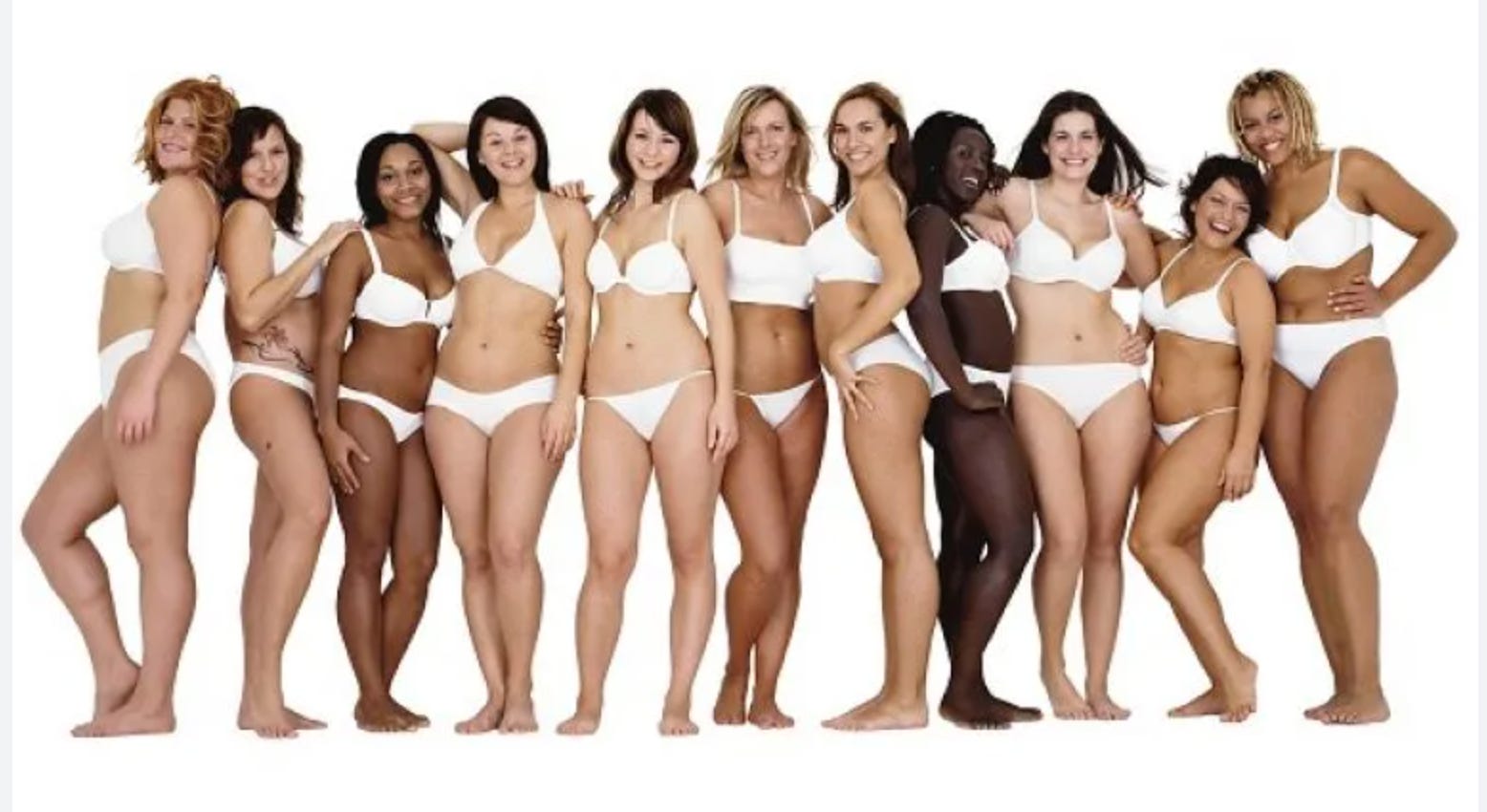
It’s so blindingly white, I need to squint to write the rest of this paragraph. Now compare this with Tony Soprano. About a month ago, he was favorably contrasted with male beauty influencer Clavicular. Notice how, despite decades of Gandolfini’s undeniable, if unlikely, sex appeal, there was never an ad campaign of Tony Soprano look-alikes against a bright white background smoking cigars in their tank tops. 1 Why would there be? Tony Soprano was one-of-a-kind. There wasn’t a political movement of balding fat Italian men demanding more representation. Good thing: shudder to think what an Instagram grid full of Soprano-esque influencers would look like.
Unexpected beauty has taken a broader, more cosmic turn in recent years. AI was supposed to replace human influencers, yet it hasn’t. There is an infeffable quality to beauty in general, let alone human beauty in the context of The Great Digital Replacement. AI “beauty” may well have become the final straw for many who have lived with decades of tech-legible ugliness in our cities, our movies, etc.
Not that I want to predict trends or anything. My days of prophesying the arrival of a future counterculture are well behind me. Ever since I deleted TikTok months ago, I have panned for the gold of unexpected beauty on the Substack feed. The usual treasures from Alexander Sorondo, who writes about the colorful customers and coworkers he works with at the local grocery store in Miami; Daniel Falatko’s profile of a rapper who rose from absolute poverty to riches despite the media largely ignoring him; Ross Barkan’s disarmingly heartbreaking essay about his late father; Katherine Dee’s cartography of the Internet as a fairyland; Emma Newman-Holden’s twisted Borgean-Barthelmian visions for the flash-fiction age; Dia Lupo’s haunting elegy of a coworker’s death in a national tragedy…
Just look at the intro to Sudana Krasniqi’s latest story:
The lingering smell of Marlboro reds and lemon-scented cleaning solution in the mostly empty dive bar made me feel eleven years old again. Some little girls had Barbie dream houses or gymnastics class to look forward to after school. I had the pool table at my fathers bar. You haven’t been able to smoke indoors in this city since the Bloomberg administration, which could explain why I haven’t felt anything resembling “young” since. But city laws never held much weight in places like this.
Poetry can be found everywhere, even in full-flavored cigarettes and Pledge.
One more: briffin glue returns with the most ambitious Substack post I have seen yet. I highly recommend reading it with the article voiceover. Trust me.
Not that I’m saying beauty only strikes in the Substack Notes algorithm, if you’re lucky. Ideally, you would stop looking at your phone period. But then what? Are you still having ruminating anxious thoughts in your head? Then what — cable news? What would life be like if you looked as tirelessly all around you for hidden, everyday beauty as you did on your phone for the latest information on the most manufactured trends?
So many normies have asked me what psychedelics are like: what strange things do you see? It’s not like you don’t hallucinate when you take them, but that’s besides the point. From the beginning alone, before the trip even starts, you are open to the mysteries and wonders that are all around you. I have been clean for two and a half years, but I still look around me for small signs of the miraculous. As I am writing this, my kitchen ceiling has a pinkish hue from the sunlight refracted through my orange curtains. The light is beckoning me to go outside and enjoy this lovely day. Perhaps it is beckoning you as well.
This is going to become another one of those Washington Square contests, isn’t it?
The algorithm is an ambivalent drug dealer, it really only knows the addict on a surface level. As you point out it’s possible to keep eyeballs stuck on these apps with the repetition and delayed gratification of a poker machine, but just like worst perversions of the beauty industry itself (the stuff that does permanent damage to bodies) it can range from shallow to toxic. So it is beauty needs to move people to speak to something deep inside the self. It’s interesting you mentioned buddhism where beauty and reality itself is also presented as an illusion; of existence and for the potential of attachment. But I gotta stay grounded and save the transcendental for the meditation chair.
One thing I would say about the lack of Godfather influencers, is what we did get (one could argue with more time, also a misinterpretation) is a celebration of nihilism. I stopped watching Breaking Bad when it was just him being bad for no conceivable reason. Was Game of Thrones a thing of beauty even in dark energy? Dunno I couldn’t sit through an episode.
But finally as you also as usual *beautifully* frame with just enough grace to the boomers whilst holding them to account, of course the cultural output, like the politics is always a mirror to the audience to some extent. To quote TISM (seminal Australian band from the 80s to now) “As a mistral employee once told me you’re only as good as your fans”.